Showing posts with label aquascaping feature. Show all posts

Wednesday, August 26, 2009

Aquascape of the Week: Kirua's "A Stony Heart"

Been a while since I've done an aquascape of the week feature (maybe I should change it to just "Featured Aquascape") but with the recent revealing of the IAPLC results, it means entry photos will begin surfacing around the web. This beautiful aquarium placed 97th in the world, which out of the 1000+ entries is a pretty big honor. This tank really deserves it. I love how the hardscape forms the center of the tank, and the play with light and dark areas really adds to the visual interest. Congratulations Kirua! More information on this tank can be found here.

Stay tuned for the IAPLC contest top 10 tanks, I've been hunting around for them and will post them as soon as I find them!

Wednesday, July 29, 2009

Aquascape of the Week: Jorge Oliveira

This aquascaped aquarium is a simple, but stunning work from Jorge Oliveira. Great use of the Golden Rule and a V shaped aquascape. For more information on the aquarium, including plant species, lighting and fertilizer specs, and hardscape pictures, check out the thread here.

Monday, June 15, 2009

Aquascaping Topic: Hours Per Week

These last few weeks of hunting for a new apartment have squeezed my schedule and I finally got a chance today to give my aquascapes a good trim, which took the better half of two hours. Overall, I tend to be on the low end for hours per week I devote to aquascaping. Usually I spend anywhere from an hour to two hours per week on my 2.5 tanks (one is less than a gallon).

I think many people have an inflated sense of how many hours per week it takes to maintain a decent looking aquascape. How many hours per week do you spend on your aquascapes?

Tuesday, June 09, 2009

Aquascape of the Week: Uttoshii's Island Layout

Here's another great aquascape using Myriophyllum matogrossense. I seriously need to get my hands on some of this stuff once I move and re-scape my 46 gallon tank. Uttoshii has used driftwood and sand to his advantage to create a really nice island type aquascape. The tank is only 6 weeks old, so I'm eager to see what it looks like when it matures a bit more. Great job Uttoshii! Read more about the tank here.

Monday, June 01, 2009

Aquascaping Topic: Emersed Growth

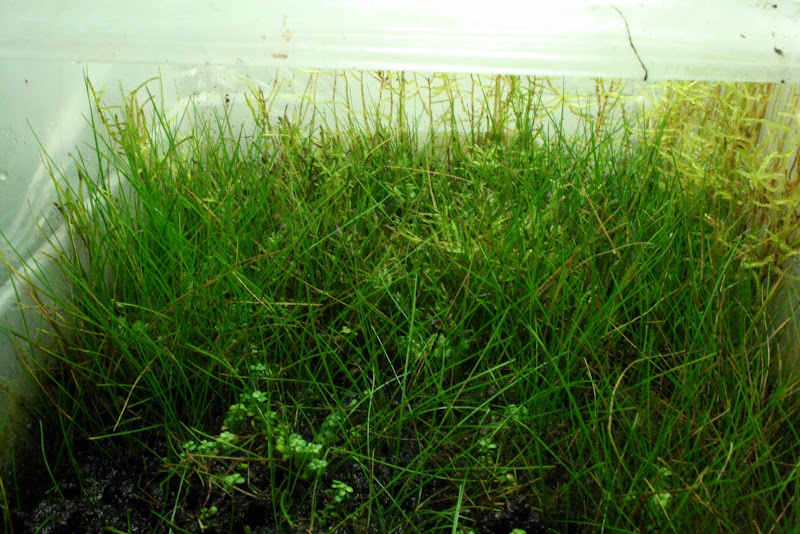
I've finally thrown in the towel on the last of my emersed grow out containers, since the bulb burnt out and I didn't realize it, and all my dwarf hairgrass in it died. I have to admit, when it works, growing plants emersed is much faster and less intensive than a grow out tank. Not having to dose fertilizers, worry about CO2, or plants that wont stay planted is fantastic. It does have its drawbacks though, since my HC was overrun with some sort of slime mold, and before that it was infested with little bugs. The transition from submersed to emersed and back again can be tricky as well. What about you? Have you ever tried to grow any plants emersed? Do you think it's worth it?

Wednesday, May 06, 2009

Aquascape of the Week: Nico's "Douce Ambiance"

First off, I love the plant on the top right. Not sure what it is, but the fluffy, feathery leaves are very interesting and remind me of a stand of pine trees. Nico has also done an excellent job using hardscape here, with the gnarled driftwood looking simply amazing (be sure to check out the additional photos in the thread for some sweet "ground level" shots). With all that's going on in the foreground, center, and back right, the back left feels almost neglected!

Gotta love that hill too. I wonder if that's built up substrate or just an illusion using the Glossostigma over rocks and hardscape? And all this in just a 17 gallon tank! It easily looks double that size. Excellent job Nico!

Thursday, April 30, 2009

Aquascaping Topic: Most Dreaded Algae

Algae is to the aquascaper as weeds are to the gardener. It's a never ending battle to keep your hard work from being consumed in a gooey, smelly mess. Granted, we'll never be 100% victorious, since some level of algae is natural, but it still we do everything short of using chemicals (and some people even use these in a desperate last ditch attempt) to try to get the upper hand.

While most aquascapers and planted aquarium hobbyists have probably encountered nearly every type of algae in their careers, we all have a particular type of algae we dread the most. For me, it used to be Cladophora sp., but now, I just cannot seem to kick this black brush algae (BBA). It's sprouted up all over the place and despite having my CO2 high enough to make my fish gasp it doesn't seem to want to go away. So what type of algae do you dread the most?

Monday, April 27, 2009

Aquascape of the Week: Jason Baliban's "Wainapanapa"

Inspired by the black sand beaches of Maui, Jason Baliban created this awesome aquascape from photos taken on his vacation. I love the "eroded hills" look here, and it perfectly matches what you'd see by the ocean. The round pebbles fit well too and add lots of visual interest. Check out more pictures including pictures of the beaches in Maui that inspired this aquascape in this thread.

Wednesday, April 15, 2009

Aquascape of the Week: Radek Baszak's "Up the Scarp"

A few days late due to vacation, but better late than never! This little aquascape is so visually interesting. Radek Baszak has done a wonderful job selecting and arranging plants with contrasting textures to create lots of interest, as well as that awesome rock formation. I don't know if it was many hours of teaching the fish to "stay!" or just waiting for them to be in the right place at the right time, but they are perfectly posed as well. For more information on this tank, Mr. Baszak, and the rest of his tanks, take a look around his website.

Wednesday, April 08, 2009

Aquascaping Answers: El Natural


Each week in Aquascaping Answers, I do my best answering your aquascaping and aquascaping related questions. Just leave your question in the comments section!

Well, this is the long overdue Aquascaping Answers that I've been too busy to write for a while now. Sorry if you left a question and were disappointed, I've copied them down and will try to get to them all eventually!

Unfortunately I have decided that I shouldn't spend a whole lot of money right now, and I don't think I will be able to handle dosing fertilizers every day or every other day (I'll forget...). But, there's hope! An El Naturale tank. I know that they typically use no filters, but I have already purchased my Eheim Classic 2215. My sense tells me that I could still set up an El Naturale tank, but I may have to dose Nitrogen (which is easier and cheaper than everything else in addition!), to replace the ammonia which the bacteria would be eliminating. My setup would be a 46 gallon bow-front with a DIY 96 watt PC fixture (about 2 watts/gallon) with the Eheim 2215 and a soil substrate... Is this feasible? Would I have to dose Nitrogen? How heavy should my fish-load be? Thanks for helping me get started in the planted tank niche with a beautiful tank!!

I would become fully familiar with the differences between an El Natural tank and a higher-tech Dutch or Nature Aquarium aquascape. They're very different styles, in almost every way. If you'd like to grow fast growing, high light plants, I wouldn't settle for an El Natural. On the other hand, if you are perfectly content having a "set it and forget it" tank that you can pay attention to whenever you have a spare minute every couple weeks or so, and that won't necessarily rival Amano's tanks, El Natural may be right for you. Pick which ever one you think you would enjoy more.

If you are only worried about dosing and remembering to dose fertilizers, build a simple and cheap DIY fertilizer auto-doser. It doesn't cost more than $30-$50 and you'll never have to worry about forgetting a dose again, except that is till it runs out of mix (no wonder my algae was coming back with a vengance!).

For details on an El Natural and whether or not you should dose nitrogen (I highly doubt you'd need to) I'd suggest buying Diana Walstad's book or checking out the El Natural forums on Aquatic Plant Central. The rest of the tank specs sound fine, and I'd stock it only slightly heavier than a normal tank.

Good luck!

Ask a question about aquascaping, keeping aquatic plants, plant-friendly fish, lighting, CO2, fertilizing, or any other aquarium plant related question in the comments to this post, and I'll answer them in next week's edition.

Monday, April 06, 2009

Aquascape of the Week: Renaud's ADA 2008 Layout

This week's aquascape is a really fantastic layout from the 2008 IAPLC (ADA) contest, where it ranked 176th. The "canopy" of plants is just amazing and must have been quite hard to accomplish, but it is certainly stunning. Combined with a unique orange sunset-like background, the green of the Hemianthus micranthemoides in the canopy really stands out and is just fantastic.

Tuesday, March 31, 2009

Aquascape of the Week: Norbert Sabat's 2008 ADA Layout

This aquascape is Norbert Sabat's entry to the 2008 IAPLC (ADA) Contest, with which he ranked 145th. I love the open grassy feel of the entire aquascape, with great use of different grassy plants. I like the overall "mound" shape too. I think the only thing I'd change is the driftwood on the left side; maybe a less "heavy" piece would be a little less distracting. Find out more about this tank here, and more about Norbert Sabat in this interview.

Monday, March 23, 2009

Aquascape of the Week: Reca's "O Fogar da Ayama"


When I saw this aquascape over on the Aquascaping World forums this morning, I knew it had to be the Aquascape of the Week. It's a veritable wall of green, but Reca has skillfully used different leaf shapes and textures to break up the monotony. Nothing jumps out at you, there are no bright red plants, but it's infinitely deep. It's one of those aquascapes that you need to look at for a long time to take it all in, there's just so much interesting stuff going on! Nice job Reca! You can find his blog here.

Monday, March 16, 2009

Aquascape of the Week: Filipe Alves Oliveira's "Origens"

I love Filipe Alves Oliveira's aquascapes and this one is no different. The different textures in this "mound" style aquascape work well (I particularly like the Crypt in the front left foreground) and the subtle use of red creates a nice focal point. Check out more of Filipe Alves Oliveira's aquascapes on his blog (all in Portugese) or specifics about "Origens" in his post on Aquascaping World.

Monday, March 09, 2009

Aquascape of the Week: Pereiro's "Claudia's Garden"

The shape of this iwagumi-like aquascape is just beautiful and reminiscent of a mountain peak. Although the photography is not quite professional, I had to include this aquascape for the natural beauty of it. The school of colorful fish around the mound just add to the effect. I also love how the Hemianthus callitrichoides is creeping up the mountain. Very well done! To follow this aquascape and see more pictures, check out the thread here.

Wednesday, March 04, 2009

Aquascaping Answers: Natural Light

Each week in Aquascaping Answers, I do my best answering your aquascaping and aquascaping related questions. Just leave your question in the comments section!

I'm trying to do a natural tank, currently with low light basic fluorescent. I want to add some high light requiring plants and use natural sunlight for a few hours, probably in the morning. Is there a 'right' amount of natural sunlight. A proper amount of time and portion of the tank to receive light? What other considerations and temperature controls should I consider?


I'd be very careful trying to use direct sunlight. It's far more intense than any artificial light, and like you hinted at, can cause temperature issues as well as algae issues. Diana Walstad's "el Natural" style of fishkeeping advises placing the tank near a southern-facing window so it gets a few hours of sunlight. This means it won't really get blasted by the sun at any point during the day directly. I don't know the exact details, but I don't think that this would be enough for a high light plant to grow well in. You also have to consider the angle at which the light is entering the aquarium. You're going to get most of your plants growing sideways towards the sunlight. As for temperature, the sunlight will heat your tank quite a bit, especially in the summer, so you may need to use a fan or chiller to keep the tank cool. Also, since it's likely going to be next to a window, keeping the tank heated in the winter will be more expensive and require a better heater. Sunlight also tends to encourage algae, so you'll have to work a little bit harder to keep that in check. Overall, I'd say using natural sunlight isn't a bad idea if you want an "el Natural" style tank with low light, low maintenance plants. However, I don't think high light plants will thrive under these conditions. They need constant and direct high intensity light to really grow well.

Any tips on making DIY caves? I'm going to make some for my fish soon - preferably from natural materials. Any suggestions?

Well the most natural caves would be crevaces made by piles of rocks. Just make sure to select rocks appropriate for the aquarium and start building. If you're looking for a cave for breeding purposes, although not the most natural, halved coconuts and upside-down flower pots with a hole for entrance are the easiest ways to go.

Ask a question about aquascaping, keeping aquatic plants, plant-friendly fish, lighting, CO2, fertilizing, or any other aquarium plant related question in the comments to this post, and I'll answer them in next week's edition.

Tuesday, March 03, 2009

Aquascape of the Week: Eric Monteiro's "Enchanted Hills"

Sorry for the delay in this week's aquascape, had to deal with some winter weather! This aquascape uses light and dark very effectively to highlight certain areas of the aquarium. The light plants in the background create a focal point, while the lighter plants in the foreground draw the view around the tank. The discus fish are very impressive as well! Fore more information and pictures, visit Eric's entry page for the 2004 AGA contest.

Wednesday, February 25, 2009

Aquascaping Answers: Water Softners

Each week in Aquascaping Answers, I do my best answering your aquascaping and aquascaping related questions. Just leave your question in the comments section!

Well I didn't get any questions on last week's post (which was pretty big anyway!) so I'm going to dig up a question that I got in my email for this week:

How do you avoid a temperature change when doing the water change? I can't use tap water because we have a water softener. I can use the outside faucets, because they aren't on the softener, but then I can't control the temperature. This is an 80-gallon tank, so that's too much water to heat on the stove.

If you can't use your tap water (which I'll touch on later), the only other way is by investing in some big containers that you can fill up via the outside taps and leave inside so they warm up to room temperature (which should be somewhat close to your tank temperature). You may have to leave them overnight. You can also throw an old aquarium heater and a power head into them to speed up the process if you have an extra.

This sounds like it may be a lot of hassle to do weekly though, so I'd test your tap water and see what it looks like. You may be able to use your tap water after all. Well water and water in rivers and streams contains magnesium and calcium. A water softner just swaps out magnesium and calcium for sodium. Test pH, GH, and KH and see if it's within limits or at all similar to your tank water. I'm guessing the tank was originally filled up via the outside taps? If the water in the tank is much harder, and the tap water is softer, but within reasonable limits, I'd simply do a series of small water changes with tap water, maybe a few gallons a week, to acclimatize the fish and plants to the new tap water. Keep testing and once your tank water is about the same as your tap water, you should be ready to start doing water changes from the tap.

In the end, it's much easier to acclimatize your fish to your water chemistry than the other way around. Most fish and plants will do fine in stable water conditions, no matter if they are hard or soft. The key is to minimize large changes. Good luck!

Ask a question about aquascaping, keeping aquatic plants, plant-friendly fish, lighting, CO2, fertilizing, or any other aquarium plant related question in the comments to this post, and I'll answer them in next week's edition.

Monday, February 23, 2009

Aquascape of the Week: Renee So's "Morning Glory"

This tank won second place in the small tank category last year in the AGA aquascaping contest and I just love how Renee has used moss to create such a unique aquascape. The moss shapes remind me of trees or perhaps even giant mushrooms. Check out more images and details of the tank at the AGA site.

Wednesday, February 18, 2009

Aquascaping Answers: Surface Film and CO2 Safety

Each week in Aquascaping Answers, I do my best answering your aquascaping and aquascaping related questions. Just leave your question in the comments section!

Lots of good questions this week, so I'll jump right in:

I have seen a CO2 test by tetra in a LFS, I have also read its possible to measure CO2 with PH and hardness. What is the best and more accurate way of testing CO2?

You're right, you can get a general idea of CO2 levels from pH and KH (carbonate hardness). However this method is rough at best, since it assumes that there are no other acids or bases present in the aquarium. The most accurate way of testing CO2 levels that I have found is to use a drop checker. These are tiny glass or plastic tools that stick onto the aquarium wall and have a pocket of air separating a reagent from the aquarium water. The CO2 in the aquarium water travels through the air pocket and causes the reagent to change colors depending on the amount of CO2 present. These are generally fairly easy to make yourself, since the reagent is simply a fixed KH 4 and pH test solution mixed together, or you can buy a nice looking glass one for under $15. The only drawback of these is that they can be somewhat slow to react since the CO2 has to travel across the air pocket and into the reagent. But they are by far the most accurate method.

I have a 5lb CO2 tank. Do I need to take any safety precautions? I read the MHDS and it says that the space should be well ventilated. That is tough. What do you do? Would a carbon monoxide detector pick up CO2 before I suffocate?

If you can, I would follow the MHDS recommendations by all means. However, "well ventilated" can be a window or door to the outside. We all breathe out CO2 (and back in again) and it's present in the atmosphere, so unless your CO2 tank is in a small sealed area and your system is leaking drastically I don't think it should be too much of a problem (on a 0-4 scale it's listed as a "1 - Slight hazard"). The issue arises in a sealed or nearly sealed area where the CO2 levels can rise so far that it limits the amount of CO2 your body can get rid of. This is exactly the same thing that happens to fish when CO2 is too high. You would (like the fish) probably notice something was wrong (rapid breathing, headache). I don't think a carbon monoxide detector will detect CO2 though.

I think a more important safety measure is to make sure the tank is secure at all times with a chain or rope so it cannot tip over (causing liquid CO2 to enter the regulator and explosively decompress). This especially goes for transporting it. I've heard many stories of driving with a CO2 container not properly secured that hits something and opens the valve, instantly flooding the car with CO2. Or, even worse, if it falls over and hits something, breaking the valve off, it could become a very, very dangerous gas-propelled missile. Just be safe and realize you are dealing with a highly compressed gas in a pressurized container.

My 100ltr planted Cube has developed a surface film of algae, I tried the usual paper towel trick which does lift it but its back in an hour or so. I don't want to agitate the surface obviously but what else will work? I did introduce a new food recently so I'll stop that first. Any other suggestions?

This surface film is a build up of organic waste and proteins. I'd try reducing the amount of food you feed your fish if it's thick enough to bother you. Usually, it's just a slight film, but in bad cases it can get thick and may pose a risk to your fish since it can prevent gas exchange. The only way to get rid of it is to use a paper towel (like you've been doing) or to change your filtration so it agitates the water slightly (but not enough to waste all your CO2). One of the most effective tools to do this with is the ADA Lily Pipes. They are shaped to create a tiny vortex which sucks the surface scum off the surface. A similar effect can sometimes be achieved by placing a powerful outflow just beneath the surface far enough to eliminate ripples (or aimed slightly downwards to achieve the same thing). Good luck!

Ask a question about aquascaping, keeping aquatic plants, plant-friendly fish, lighting, CO2, fertilizing, or any other aquarium plant related question in the comments to this post, and I'll answer them in next week's edition.

Popular Posts

Sponsors

PetSmart

Planted Aquarium Books