Showing posts with label plant profile. Show all posts

Friday, March 30, 2007

Anubias barteri var. nana

Common Name: Anubias nana
Scientific Name: Anubias barteri var. nana
Geographic Location: Central Africa
Temperature: 72F-80F
pH: 5.5-9.0
Light: Low (1.5WPG) to Moderate (2.5WPG)
Growth: Slow
Difficulty: Beginner

Anubias are an extremely hardy creeping plant from Africa, but most varieties grow far too large for normal sized aquariums. However, the Anubias nana is one of the smaller varieties, growing only about 6 inches tall. Like other Anubias, the Anubias nana grows very slowly, at about one new leaf a month. The leaves are thick and rigid and almost nothing will eat them, making it perfectly suited for aquariums with more destructive fish. The leaves can also last for months, if not years.

Anubias are similar to Java Ferns in that they grow off of a rhizome which must not be buried in the substrate. For best results, tie the rhizome to a piece of driftwood or rock, and the roots of the Anubia will soon anchor the plant. Also, placement is key for these plants as they creep horizontally more than vertically and grow in one direction, so plan accordingly. In order to trim an Anubia, simply cut off part the rhizome with sharp scissors or a knife, making sure to cut enough rhizome to contain a few leaves if you wish to keep the trimmed portion to grow into another plant.

Anubias nana makes few demands in terms of nutrients or light. In fact, because the leaves grow so slowly and last so long, high light leads to algae growth on the surface of older leaves. Therefore, place the Anubia nana out of direct light, or in an aquarium with moderate light. An Anubia will grow with almost no attention and needs very little fertilization. Even with ample fertilization and CO2, you will not see much of an increase in growth.

Perfect for beginners or those who never thought they could grow plants due to destructive fish or low light, Anubias nana can add contrast to an aquascape with large, lush bright green leaves and require little or no effort to maintain.

Tuesday, November 14, 2006

Hygrophila Polysperma "Rosanervig" - Sunset Hygro

Scientific name: Hygrophila polysperma var. Rosanervig
Common name: Sunset Hygro
Geographic location: Asia
Temperature: 68F-84F
pH: 5.0-8.0
Light: Low (1.5WPG) to High (3WPG+)
Growth: Fast
Difficulty: Beginner

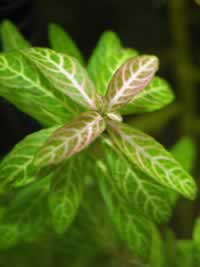
Hygrophila polysperma "Rosanervig," or Sunset Hygro as it is more commonly known, is a very versatile and beautiful cultivated variation of H. polysperma. Its leaves have veins of white (thought to be the result of a harmless virus) and turn shades of pink and red under adequate light. An undemanding plant, Sunset Hygro does not require CO2 or high light to grow. However, if these are provided, the plant will grow very rapidly, often requiring weekly trimming. Through frequent trimming the plant can be trained to take on a low, compact, bushy form and thus it can be a midground as well as a background plant. It is a perfect plant for beginners or lower light, low tech aquariums as it can survive in almost any conditions. If well trimmed and trained, it can also make a gorgeous centerpiece in an aquascape.

Sunset Hygro is fairly easy to obtain from other hobbyists but may be harder to buy in local fish stores due to its nuisance weed status. If you do need to get rid of some, please do not dump it into local waterways as it can clog them rapidly and kill off native species. Instead, put it in the trash.

Overall, Sunset Hygro has been one of the easiest plants to grow for me, and although it was a bit troublesome at first to work into an aquascape, through frequent trimming it has taken on a more attractive bushy appearance that blends will in my aquarium.

Thursday, October 19, 2006

Vesicularia montagnei "Christmas Moss"


Common Name: Christmas Moss, Xmas Moss
Scientific Name: Vesicularia montagnei
Geographic Location: Unknown
Temperature: 65F-77F
pH: 5.0-7.5
Light: Low (1.5WPG) to High (3WPG+)
Growth: Slow
Difficulty: Beginner

Christmas Moss is as mysterious as some of the other mosses in the aquarium hobby. There is no consensus on its geographic origins and even the scient
ific name has a tendency to change. Its growth habits and appearance are just as varied. When grown attached to a piece of driftwood or rock, it forms triangular fronds in the shape of Christmas trees (hence the common name). If allowed to grow free floating, it tends to have a much less organized appearance and the triangular fronds are much less pronounced. In this form, it is often confused for the much more common Java Moss. In lower light, it grows much less densely, and again, is often much less organized in structure. Only under higher light conditions, attached or anchored to an object, does Christmas Moss show its true structure. It will form a pillowy bush of triangular fronds that is very attractive and undemanding.

This moss is very easy to grow in the aquarium, as it will grow with almost
any amount of light. Although not as hardy as the legendary Java Moss, it will survive with low light and no CO2. Growth will not be the ideal structure and will be considerably slower, but it will still live. Like other mosses, Christmas Moss prefers cooler temperatures, under 77F. Over this, it tends to suffer, growing more slowly.

As an aquascaping element, its uses are limited to covering hardscape (rocks, driftwood) or creating a moss wall. A moss wall is created by sandwiching the moss between two pieces of mesh and placing this in the back or sides of a tank. The moss eventually grows through the mesh and covers it up, creating a wall of attractive triangular fronds (as seen in the picture above). It can be used as a carpeting plant, however this is not recommended, as it easily gets choked with mulm and debris and becomes an algae magnet.

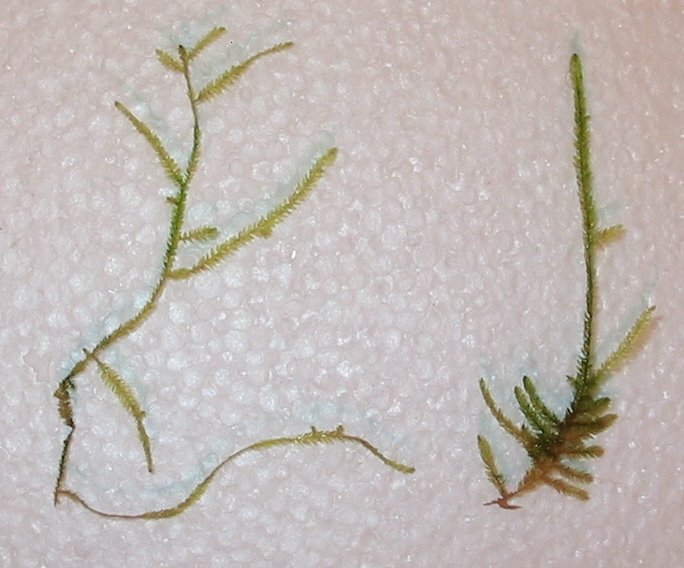
Christmas Moss is best bought from other hobbyists who have it growing under ideal conditions in their own aquariums (thus making identification easier). Getting it in a local pet store or online can be risky, as Java Moss can be passed off as Christmas Moss at less than reputable establishments. Christmas Moss can be identified by its more regular branching pattern and slightly different leaf shape. In the picture below, the moss on the left is Java Moss and on the right is Christmas Moss.


Shrimp and fish fry use it as cover and it is also an excellent source of food for both, harboring tiny infusoria (bugs). Overall, Christmas Moss is an excellent plant for covering hardscape, filling in gaps, and creating living backdrops in any aquarium.

Tuesday, October 17, 2006

Blyxa japonica


Common Name: Blyxa japonica
Scientific Name: Blyxa japonica
Geographic Location: Southeast Asia
Temperature: 68F-78F
pH: 5.0-7.0
Light: Moderate (2.5WPG) to High (3WPG+)
Growth: Moderate
Difficulty: Beginner

Blyxa japonica is a great plant for aquascaping. It is not very demanding, only needing moderate light and CO2 injection, and it forms such beautiful grassy effects. Widely used by Takashi Amano in his nature aquariums, this plant prefers acidic water. It is in fact, not a grass-like plant, but a stem plant with a tiny distance between leaves on the stem, creating a look of grass. In higher light, newer leaves will turn a goldish-red color. This can be one of the most frustrating plants to get rooted however, as they are very buoyant and are slow to grow roots to hold themselves in. Once you get a few plants rooted though, they will grow new shoots out of the base which can be trimmed off and replanted to propagate the plant. It appreciates a nutrient rich, fine substrate since it is a heavy root feeder. It fits well in the midground or foreground of a larger aquarium and can even become a background in a smaller tank. The plant will get about 4-5 inches in height when mature.

The best place to get this plant is either from another hobbyist or from an online plant retailer. It ships relatively well, provided it is packaged well since it is fairly fragile. Finding it at a local store is highly unlikely. However, I highly recommend this plant for its aesthetic beauty and easy care.

Sunday, October 15, 2006

Microsorium pteropus var. Narrow


Common Name: Narrow-leaf Java Fern
Scientific Name: Microsorium pteropus var. Narrow
Geographic location: Southeast Asia
Temperature: 64F-84F
pH: 5.0-8.0
Light: Low (1.5WPG) to High (3WPG+)
Growth: Slow
Difficulty: Beginner

The Narrow-leaf Java Fern is a relatively new plant on the aquarium scene. It is a variation of a regular Java Fern that has much narrower, longer leaves. The leaves never get wider than a centimeter or two (less than 1 inch) but otherwise the growth requirements are just as easy. It doesn't need a lot of light and will survive in just about any amount. However, it will do best in medium to high light. It can tolerate almost any temperature and any pH, just like the regular Java Fern. It also grows quite slowly, but does not need CO2 or large amounts of fertilization. It is ideal for placement on driftwood or rocks as it roots onto objects and does not need to be (and should not be) planted in the substrate.

The true beauty of this plant is its ease of care combined with its unique long wavy leaves. If grown in bunches, stands of these leaves add a wonderful affect to the aquascape. Or, you can plant a single plant on driftwood and have it grow long leaves and look like a tall grass. Either way, it is virtually indestructible. Propagation is easy, simply split the rhizome or separate plantlets that form on the ends and undersides of leaves. The only things to watch out for are to make sure you don't bury the rhizome (the big root/stem that all leaves sprout out of) in substrate and make sure it doesn't get covered in algae as it is a slower growing plant. You can't go wrong with this easy to grow, beautiful variation on a Java Fern.

Monday, October 09, 2006

Ludwigia inclinata var. verticillata "Cuba"

Photo copyright Oliver Knott

Common name: None
Scientific name: Ludwigia inclinata var. verticillata "Cuba"
Geographic location: Cuba
Temperature: 72F-84F
pH: 5.0-7.5
Light: High (3WPG+)
Growth: Fast
Difficulty: Advanced

Ludwigia inclinata var. verticillata is a beautiful stem plant. Its whorls of copper colored leaves can add a bouquet of color to any aquarium, but this plant is not for the beginner. It is very demanding in terms of light and fertilization. CO2 is a requirement as is regular NPK and trace element fertilization. Without CO2, the plant will have larger green leaves and will grow much more slowly and less full. It is a heavy iron user, and if new leaves are pale or white, the plant is not getting enough iron. It also demands high light, at least 3 watts per gallon. Each stem can reach 4 inches wide, so adequate space is also a must for this plant. It will quickly outgrow most smaller aquariums. When the ideal conditions are provided, this plant will grow very fast and will form multiple branches and side-shoots. Trimming it can be difficult, however, since it does not handle frequent trimming well. If topped, the rooted portion may wither and die. Therefore, most aquascapers will remove the rooted portion and just replant the top.


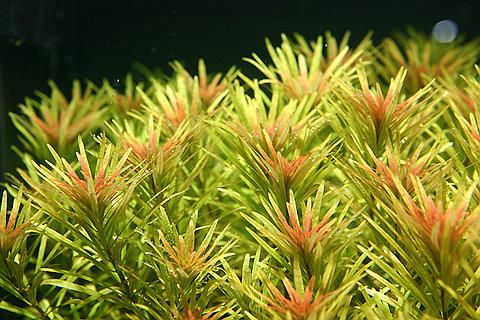
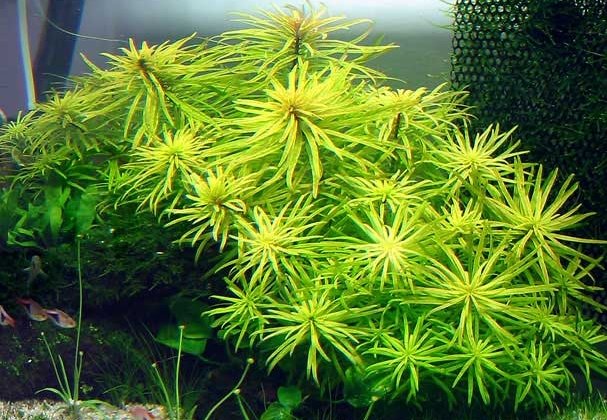
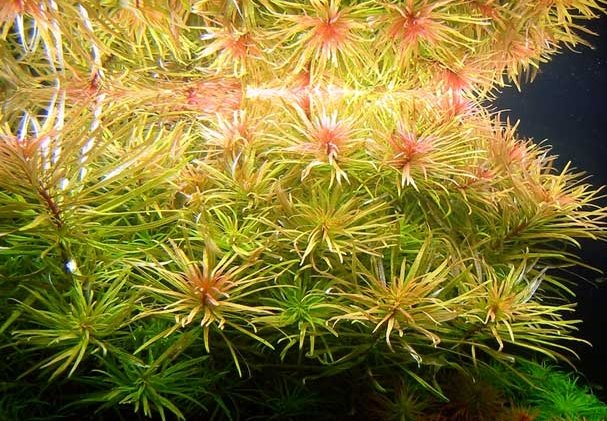
Below, you can see the variations induced by different conditions. Most likely, the differences between the two pictures is caused by lower trace dosing, lower light and CO2 (left) and higher trace dosing, higher light and higher CO2 (right).


Although I don't have any experience growing this plant myself, I hope to very soon if I can get my hands on some trimmings. I also expect I will need to upgrade to pressurized CO2 first in order to get the CO2 concentrations necessary for healthy growth. All of the accounts I have heard about this plant though have been that it is a beautiful plant that grows like a weed if given the right conditions.

Saturday, September 23, 2006

Limnophila aromatica


Common name: Rice paddy herb
Scientific name: Limnophila aromatica
Geographic location: Southeast Asia
Temperature: 70F-85F
pH: 5.0-8.0
Light: High (3WPG+)
Growth: Moderate
Difficulty: Moderate

L. aromatica is a very pretty plant for the aquarium, and it is easy to grow as well, provided you have enough light. It looks similar to the much harder to grow P. stellatus or L. inclinata "Cuba" with whorls of reddish-purple tinted leaves. It grows at a moderate pace and is tolerant of a wide range of water conditions. It does require fertilization and CO2 to grow to its full potential. In the aquarium, it is best suited in the midground as the deep purple undersides of the leaves tend to make it a focal point. It can be trimmed by cutting the tops off and replanting them in the substrate where they will grow roots. As a side note, L. aromatica is also used in Vietnamese cuisine as an herb.


Monday, September 18, 2006

Hemianthus callitrichoides


Common name: HC
Scientific name:
Hemianthus callitrichoides

Geographic location: Cuba
Temperature: 65F-85F
pH: 5.0-7.5
Light: High (3WPG+)
Growth: Medium
Difficulty: Advanced

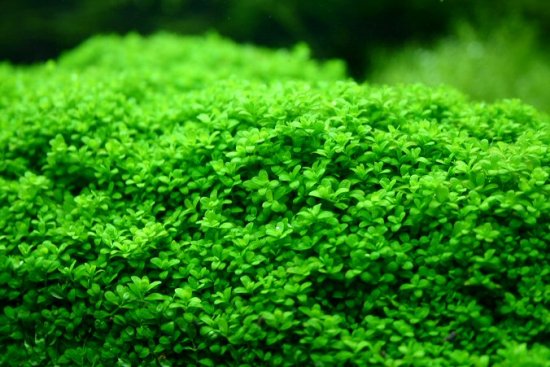
Hemianthus callitrichoides is native to Cuba, and thus probably why it's taken so long to become less rare in the hobby. It is a ground cover and has the distinction of being the smallest leaved plant available for the task. It needs higher light and CO2 to flourish and will benefit greatly from regular fertilizing. Often it is bought growing in its emersed state and therefore it is sometimes difficult to get it established in the aquarium. Keeping it anchored in the substrate is one of the most difficult feats, but small pieces of lead wieght can be used to hold it down until it can root itself. The roots are fine and delicate, so avoid disturbing it once it is established. The best way to get your hands on some is to buy it from another aquascaper. Shipping it from nurseries in Asia has mixed results as it does not take kindly to delays in shipping, and costs can become prohibitive. Growing it emersed is one option for growing it quickly. Using artifical light on timers and regular potting soil, growth of this "green gold" is much faster.

My experiences with this plant have been positive. I got my first batch from an online retailer and it was almost dead due to a delay in shipping, however it did eventually grow back. It has grown well in my tanks but it has never really been used yet, it's just been floating around. I'm currently growing it to put into an iwagumi style tank. I have been most successful growing it emersed; I have almost 2 shoebox sized tubs full of it now! I will auction it off on Aquabid when it is mature.

Popular Posts

Sponsors

PetSmart

Planted Aquarium Books