Showing posts with label fish profile. Show all posts

Friday, April 27, 2007

Salt and Pepper Cory - Corydoras habrosus


Common name: Salt and pepper catfish/cory
Scientific name: Corydoras habrosus
Geographic location: South America
Size: Up to 2cm (3/4 of an inch)
Temperament: Peaceful
Conditions: 75F-85F, pH 6.0-7.5
Skill level: Intermediate
Minimum tank size: 10-15 gallons
Plant Compatibility: Won't eat any live plants

This tiny catfish comes from warm waters in South America and is mainly a bottom dweller. Since they are so small, they are quite shy and shouldn't be kept with aggressive tank mates. Live bearers, other smaller corydoras, or tetras are ideal. If comfortable, they often just lounge out on the substrate motionless except for their little eyes. They should be kept in schools of at least 3 as they are schooling and social fish. Unfortunately, they are extremely delicate fish, and I had 2 of my 4 die on me in transit from the pet store or shortly after being released into the aquarium (habrosus means soft or delicate). This was either from trauma during transport or being caught or just stress from the whole endeavor. They also need to be fed smaller foods, especially if they are competing for food with other bottom feeders. They will eat almost anything, but sinking wafers are probably best since they dissolve into small pieces and the catfish won't have to live off the pickings that sink to the bottom from regular fish food. These are the reasons I've rated these as Intermediate for a skill level.

My Corydoras habrosus were sold to me as a pygmy corydoras, but when I actually researched them further I found that they were in fact Corydoras habrosus. They differ from the pygmy corydoras in the fact that they are speckled with black spots and have a blotchy line running from head to tail, whereas the pygmy corydoras have a single solid black stripe running from head to tail. Otherwise, they are very similar in size and behavior. Just be aware that they may be sold as pygmy corydoras, a name which has been used to sell a number of different corydoras species.

Friday, November 10, 2006

Siamese Algea Eater - Crossocheilus siamensis


Common name: Siamese Algae Eater
Scientific name: Crossocheilus siamensis
Geographic location: Southeast Asia
Size: Up to 15cm (6 inches)
Temperament: Semi-aggressive
Conditions: 72F-82F, pH 5.8-7.8
Skill level: Intermediate
Minimum tank size: 30 gallons

The Siamese Algae Eater (SAE) is well known to most veteran planted tank hobbyists. Like its name suggests, this fish eats algae, and unlike other fish that may be called algae eaters, this fish does the job. This is one of the trickiest aquarium fish to understand due to confusion and over enthusiasm for its abilities. However, it is fairly easy to care for once they are established in a tank.

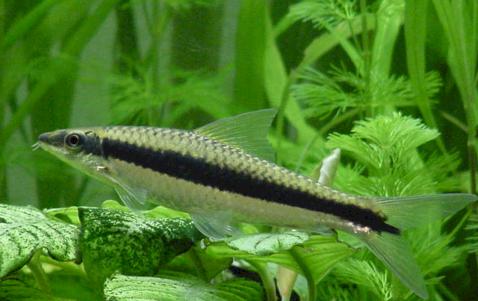
First, you need to learn how to tell a true SAE from the many similar imitations that are often sold. The Flying Fox is just one look-alike that does not eat algae to the same extent an SAE does. True SAE's have a black band down their middle, but this black band has rough edges. The stripe also extends onto the tail, which is almost clear otherwise. There is also only one stripe. The rest of the fish is a brownish-beige. Any other stripes, markings, or color on the fins and it is not a true SAE.

SAEs do eat algae, mostly hair algae. However, if there is not enough algae in your tank to satisfy the SAE, it will quickly turn its attention to any other fine leaved plants. I have had my SAE strip moss, Rotala wallichi, and Mayaca fluvalitis. I've finally learned that I simply cannot keep any fine-leaved plants in the same tank or they will be eaten.

The SAE is not a cure-all for algae. It won't eat tons of algae, so you have to help fix the problem yourself as well. Also, it won't eat all types of algae. Green spot algae and blue green algae are not on the menu. These fish also eat less and less algae as they grow larger, and they do grow large. They can top out at almost 6 inches, so a large tank is a must, especially if you have more than one. They can also get aggressive towards other fish as they get larger. They tend to like to chase and harass other fish, however I've observed mine trying to school with similar looking fish (with a black band down their middle) like my otocinclus cats and Boesmani rainbows. Perhaps some of this aggression is mistaken for attempted schooling, as I have not seen any aggression so far from my SAE.

As an interesting fact, SAEs do not have a swim bladder like other fish to control their buoyancy. Instead, they must remain swimming or they sink to the bottom. You'll often observe an SAE resting on a leaf or piece of driftwood for this reason.

Bottom line: Make sure you get the right fish, bring a book if you have to. Don't put it in with fine leaved plants or they will be eaten. Finally, have a large enough tank with other semi-aggressive fish as it may beat up on extremely shy fish.

Sunday, October 08, 2006

Cherry Shrimp - Neocaridina denticulata sinensis


Common Name: Cherry Shrimp, Red Cherry Shrimp, RCS
Scientific Name: Neocaridina denticulata sinensis var. red
Geographic Location: Taiwan
Size: Up to 3cm (1 inch)
Temperament: Peaceful
Conditions: 60-82F (ideally 72-78F), pH 6.5-7.5

Skill Level: Intermediate
Minimum Tank Size: 2.5 gallons

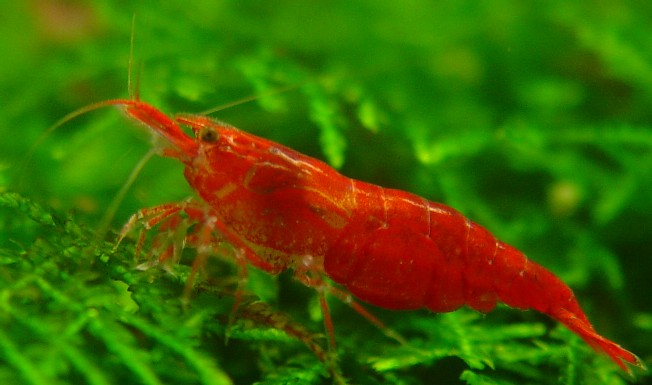
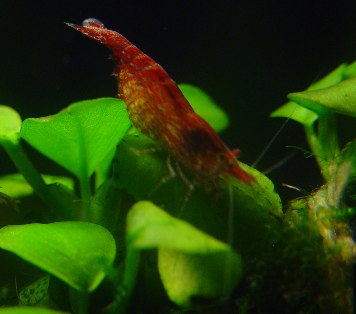
Cherry shrimp are some of the easiest shrimp to keep and breed in the aquarium. Often called Red Cherry Shrimp or RCS, these shrimp thrive in planted aquariums, where they eat algae. Juveniles should be purchased, as they adapt better to new aquarium conditions, and at least 10 should be purchased to ensure a mix of males and females. Males are often mostly clear with just a few red stripes and are smaller than females. Juvenile females are similar to males, but as they reach 2-3 months old they develop a solid red color. Around the same time, they should become pregnant with yellow-ish eggs. They carry these eggs around with them in their swimmerettes for roughly 30 days. Unlike other shrimp, the eggs hatch into miniature versions of the adults (there is no intermediate plankton stage). The baby shrimp are very small and are easily eaten by other fish or sucked up into filters. Therefore, if you want to breed these shrimp in any significant numbers, keeping them in a tank of their own with a sponge filter is the best option. Most smaller fish should leave them alone, but do not mix them with fish that have mouths large enough to eat the Cherries, otherwise they may become a snack. Shrimp are also a favorite snack of loaches and puffer fish. Other dangers include ammonia and nitrite. These shrimp are highly sensitive to these two, and will be the first to die if there is a spike in either.


I've kept Cherry shrimp on and off for about a year now, and they are definitely worth having a tank of their own. They eat algae (and are therefore a handy cleaning squad for any algae covered plants you put in their tank), they are colorful, easy to breed, and are entertaining to watch. They are vulnerable to larger fish and chemicals though, so be careful what you put into your water (copper can also prove lethal to these invertebrates) and if you want to expand your flock, keep them in a tank without other fish to snap up the babies.


The best place to buy Cherry shrimp is online through other hobbyists. They are readily available on Aquabid and through various aquarium forums, often for less than $2 a shrimp. They ship very well too, and can tolerate temperatures as low as 60F. Keep them well fed with algae or algae wafers and keep the water quality high and you will be rewarded with more Cherries than you can give away (or sell)!

Tuesday, September 26, 2006

Clown Loach - Botia macracanthus


Common name: Clown loach
Scientific name: Botia macracanthus
Geographic location: Indonesia, Sumatra, Borneo
Size: Up to 15cm (6 inches) in captivity, 38cm (15 inches) in the wild
Temperament: Peaceful
Conditions: 75F-85F, pH 7.0-7.5
Skill level: Intermediate
Minimum tank size: 30-55 gallons

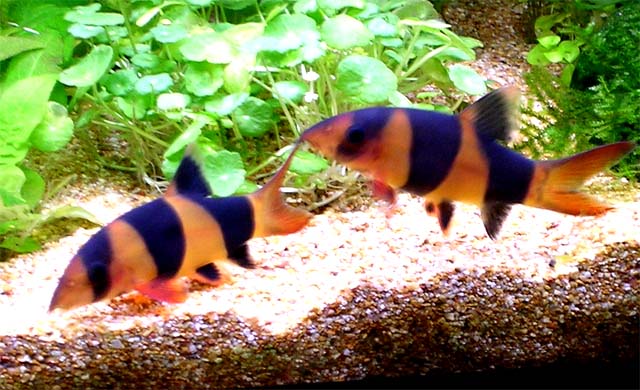
The clown loach is one of my favorite fish because of its antics and color. These loaches are diurnal (come out during the day) and go to sleep at night, literally. They find a nice nook to wedge themselves in (preferably in multiples of 3) and sleep all night, often on their sides or even upside down! Don't worry, they're not dead. They are a schooling fish and should be kept in groups of 3 or more so they have company. They are peaceful and are a great community fish, as well as having the added bonus of being a great snail eater. Although they won't likely eliminate all snails, they will keep the population in check. They need a larger tank, at least 30-55 gallons. They grow slowly, but will grow out of most tanks below this range. Bigger is better.

Clown loaches are very prone to disease since they have no scales. Ich is the most common ailment, and often they are seen in the pet store covered in ich spots (makes my blood boil). It is almost guaranteed that after you get them home they will come down with it. These poor things are sensitive to ich medication as well, so only use a half a dose to treat it if you need to. Otherwise, they are easy to take care of. The best place to buy them is a local pet store, as shipping them may stress them out, causing them to lose their color and fade. This is often irreversible.

Breeding these fish is next to impossible. Some say they don't even reach sexual maturity till they reach 30cm. Either way, very few accounts of them breeding in captivity have ever been heard of, so don't count on little baby loaches (although that would be just about the most adorable thing ever).

Overall, these fish are full of personality and add a splash of color and entertainment to any aquarium large enough to hold them.

Saturday, September 16, 2006

Blue Ram - Microgeophagus ramirezi

Male Blue Ram
Common name: Blue Ram, German Blue Ram
Scientific name:
Microgeophagus ramirezi
Geographic location: Venezuela, Columbia

Size: Up to 5cm (2 inches)
Temperament: Peaceful

Conditions: 75-85F, pH 6.5-7.0
Skill Level: Advanced
Minimum Tank Size: 10-20 gallons

Female Blue RamThe Blue Ram is a dwarf cichlid from South America, although it is now captively bred in Europe and Asia. It is a mainly peaceful fish that thrives in well planted tanks with softer water. In the wild, it lives in warm pools that are heated by the sun, so it is tolerant of higher temperatures. These fish are very complex fish behaviorally, which makes them a pleasure to own and watch. Often, they are not afraid of a hand in the tank like other more skittish fish and will hold their own against much larger, more aggressive fish. Males and females look similar, except males have a longer black spike on their dorsal fin and have no blue markings in their black spot on their side. Blue Rams form faithful pairs and are quite easy to breed in the aquarium.

I have owned many of these fish, and they are incredibly beautiful and fun to watch, but require patience, persistence, and advanced fish-keeping skills. Where they are purchased makes a big difference. Only buy them from a reputable dealer, or even better, a hobbyist who has bred the fish themselves. Otherwise they are very prone to carrying parasites or just being weak due to over-breeding and will end up dying in a few weeks. Most come from farms in Asia where they treat them with hormones to make them look more colorful at a younger age. This may lead to all sorts of health problems. It's a good idea to quarantine them before you put them in with other fish and even a preventative parasite treatment, like Jungle Labs Parasite Clear, can eliminate infections and increase chances of survival. Having a full range of medications on hand is advised with this fish, as they tend to get sick easily, unless you get strong specimens.

Blue Ram Pair with FryOnce you get past the difficult first few months, you can start thinking about breeding these fish. I've never been able to successfully breed and raise the fry, the hardest part is getting the eggs to hatch and then finding something small enough for them to eat. They do become quite aggressive once they have spawned, so keeping them in a tank of their own is a good idea. Pairing together a male and female is often difficult; just throwing two together doesn't always make a pair (much like real life!). Spawning can be induced by doing a water change with slightly cooler water (simulating a rainstorm). Eggs will be laid overnight often on a flat surface and should hatch within 7 days. Feeding the fry is difficult because most foods are too big to fit in their mouths, but they will eat infusoria (little bugs present in all aquariums, often too tiny to see) and also microworms. They grow very slowly, and unless you separate the male and female, they will be ready to spawn again in a few weeks and eat all of their young fry! If you can manage to get through these crucial stages, you will be greatly rewarded with healthy rams that can be traded, sold, or used for breeding.

Images used with permission of André Silvestre</font>

Popular Posts

Sponsors

PetSmart

Planted Aquarium Books